A Night Where Innovation Set Sail
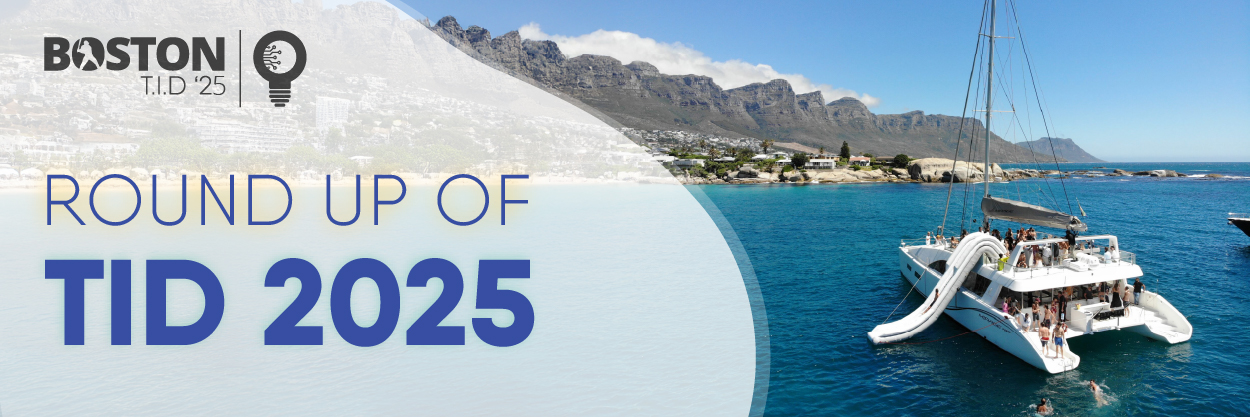
On 12th November, with the early evening light still bright over Table Mountain and the Cape Town Waterfront coming alive for the night, Boston IT Solutions South Africa welcomed industry leaders aboard The Mirage Private Charter for an evening designed to inspire, challenge and connect. While the Africa Tech Festival continued its momentum onshore, our community stepped offshore for something special; a space to rethink the future of compute, AI, infrastructure and cybersecurity against the backdrop of the Atlantic.
Across four hours, CEOs, CTOs, CFOs and strategists joined us on deck for conversations that were as open as the coastline and as forward-looking as the technologies shaping Africa’s digital leap. Supported by our partners Supermicro, Radware and Intel, the evening delivered thought-provoking sessions, genuine connection and a shared vision of what comes next for the continent’s technology landscape.
What Did We Discuss?
Supermicro
From Legacy to Liquid: Powering Africa’s AI Leap
From compute to infrastructure, Supermicro took to the deck to paint a picture of a continent on the edge of a defining technological moment.
“(Supermicro) started out as a component manufacturer and we’ve quickly moved into complete solutions…and that’s how we’re helping our customers – (through) modular systems that are scalable, that you can quickly deploy and build datacentre solutions.” – JP de Villiers, Senior Account Manager for Supermicro
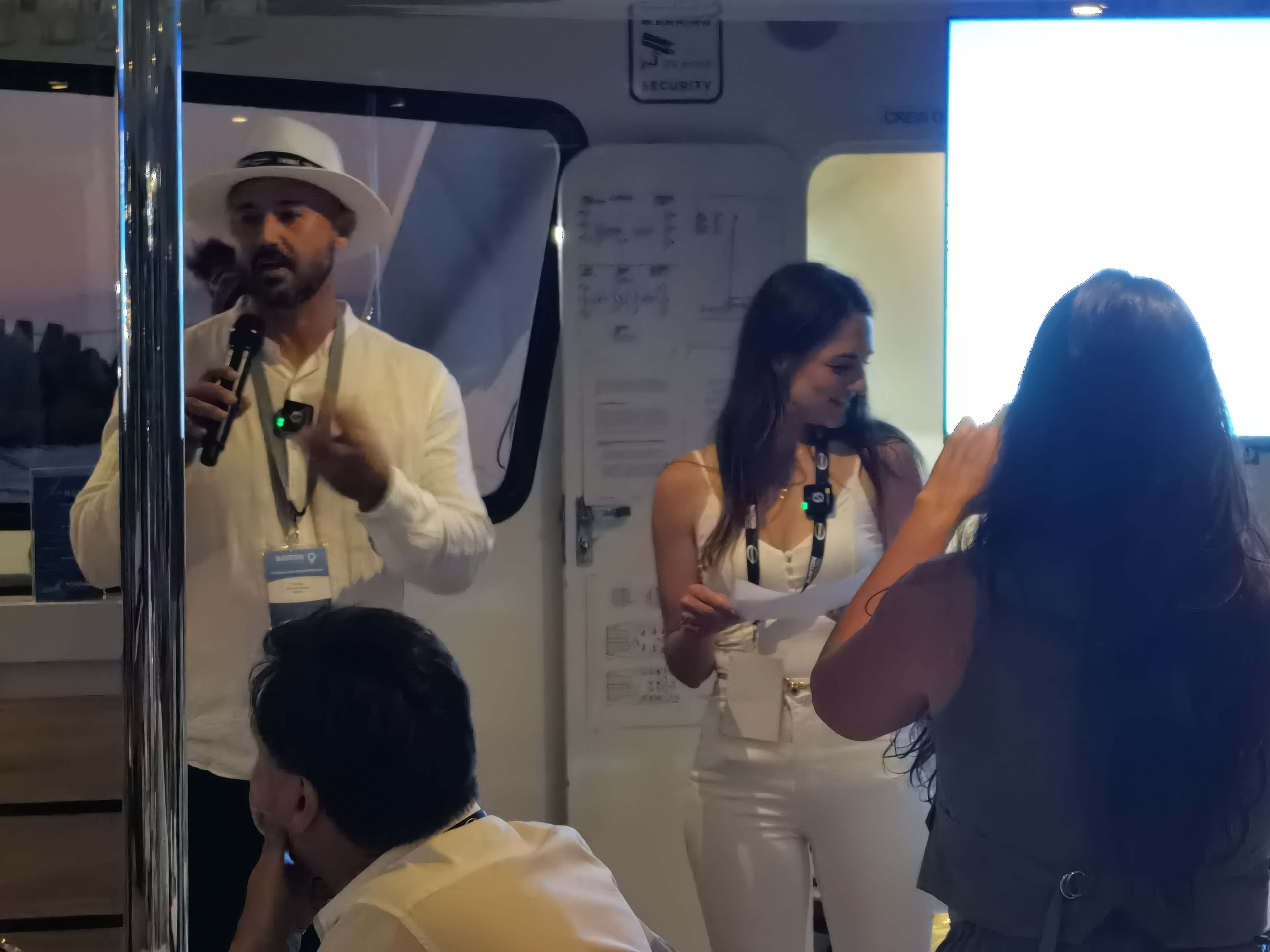
JP & Savitri doing the Fireside Chat
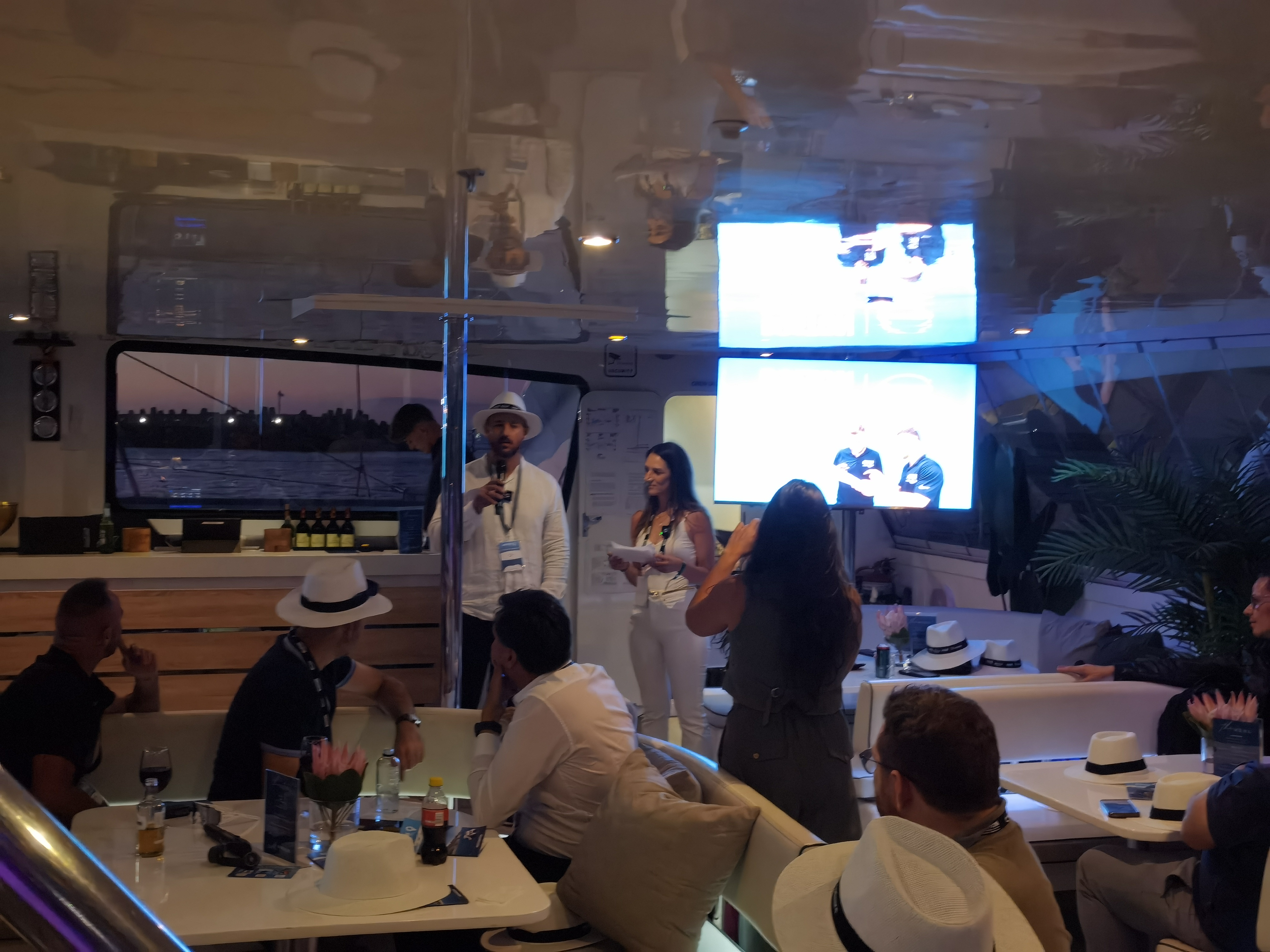
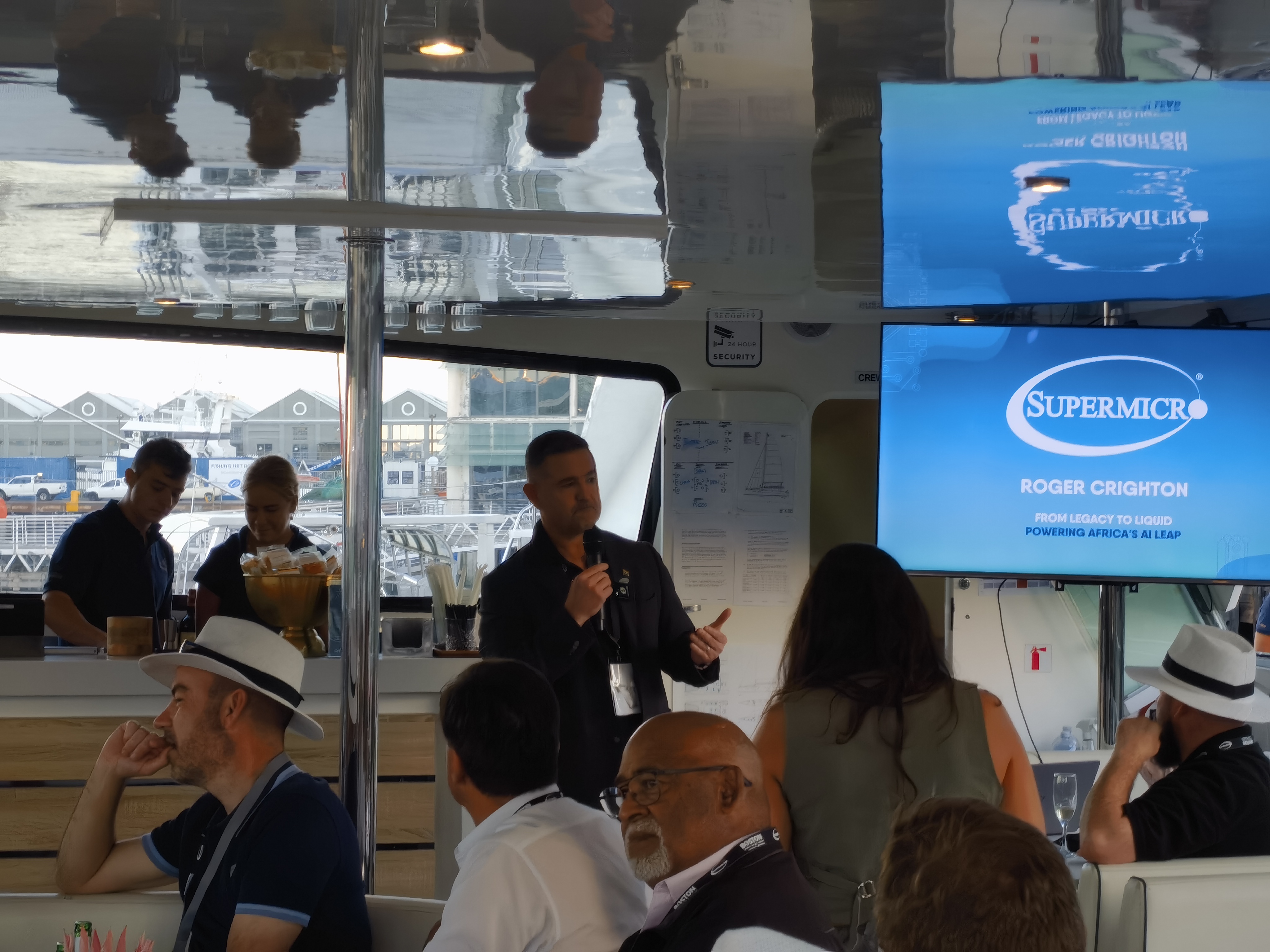
Roger Presenting
AI is accelerating at a rate that legacy infrastructure simply cannot match. CPUs have given way to GPUs drawing over 1,000 watts each, with racks now exceeding 120 kilowatts. Air cooling, once the backbone of data centre design, has hit its physical limit, a “cooling wall” that prevents density from scaling further. And in regions where electricity costs can reach R6.00 / $0.35 per kilowatt-hour, inefficiency isn’t just inconvenient, it’s unsustainable.
Supermicro’s response is transformational rather than incremental:
Direct-to-Chip Liquid Cooling, deployed at scale today.
Delegates learned how liquid cooling enables:
- Up to 40% lower power consumption
- Up to 80% smaller footprints
- Up to 98% heat-capture efficiency
This opens the door to AI factories; modular, high-density environments built exclusively for AI training, inference and next-generation compute.
Supermicro also outlined its Data Centre Building Block Solutions (DCBBS), a modular framework that accelerates deployment from weeks to days while offering predictable costs, simplified management and guaranteed performance.
And with Boston providing local expertise and integration capabilities, African enterprises can leapfrog legacy systems entirely, building data centre environments that are sustainable, future-proof and globally competitive from day one.
Radware
Fight AI with AI: Resilience at Digital Speed
Radware shifted the conversation from infrastructure to the next essential layer: security.
"Applications have evolved to be delivered in a web format, accessed anywhere, on any device – protecting these applications has been a challenge, which is even more of a challenge now with AI tools. These are some examples: Reverse Engineering Patches, AI-Driven Phishing and Deepfakes, Automated Vulnerability Discovery, Ai-Enhanced Bot Attacks & Ai-Powered CAPTCH Solving. Manually updated systems are losing ground – the key to staying ahead is adopting AI-powered, adaptive, and integrated security platforms that automate detection and mitigation, supported by expert defence teams to handle the complexity and speed of AI-driven cyber threats.” – Clinton Greeff, Regional Sales Manager: SADC for Radware
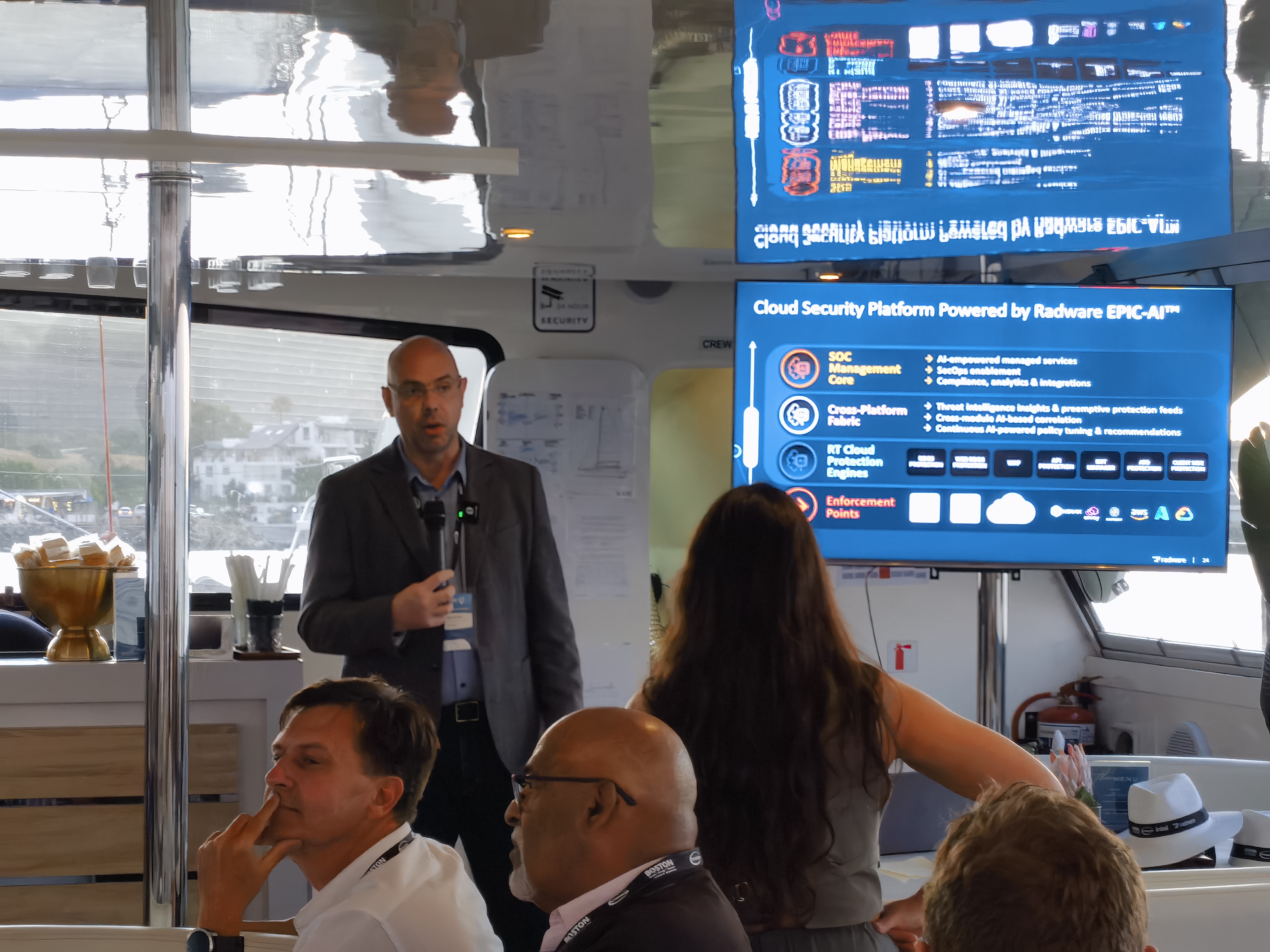
Clinton Presenting
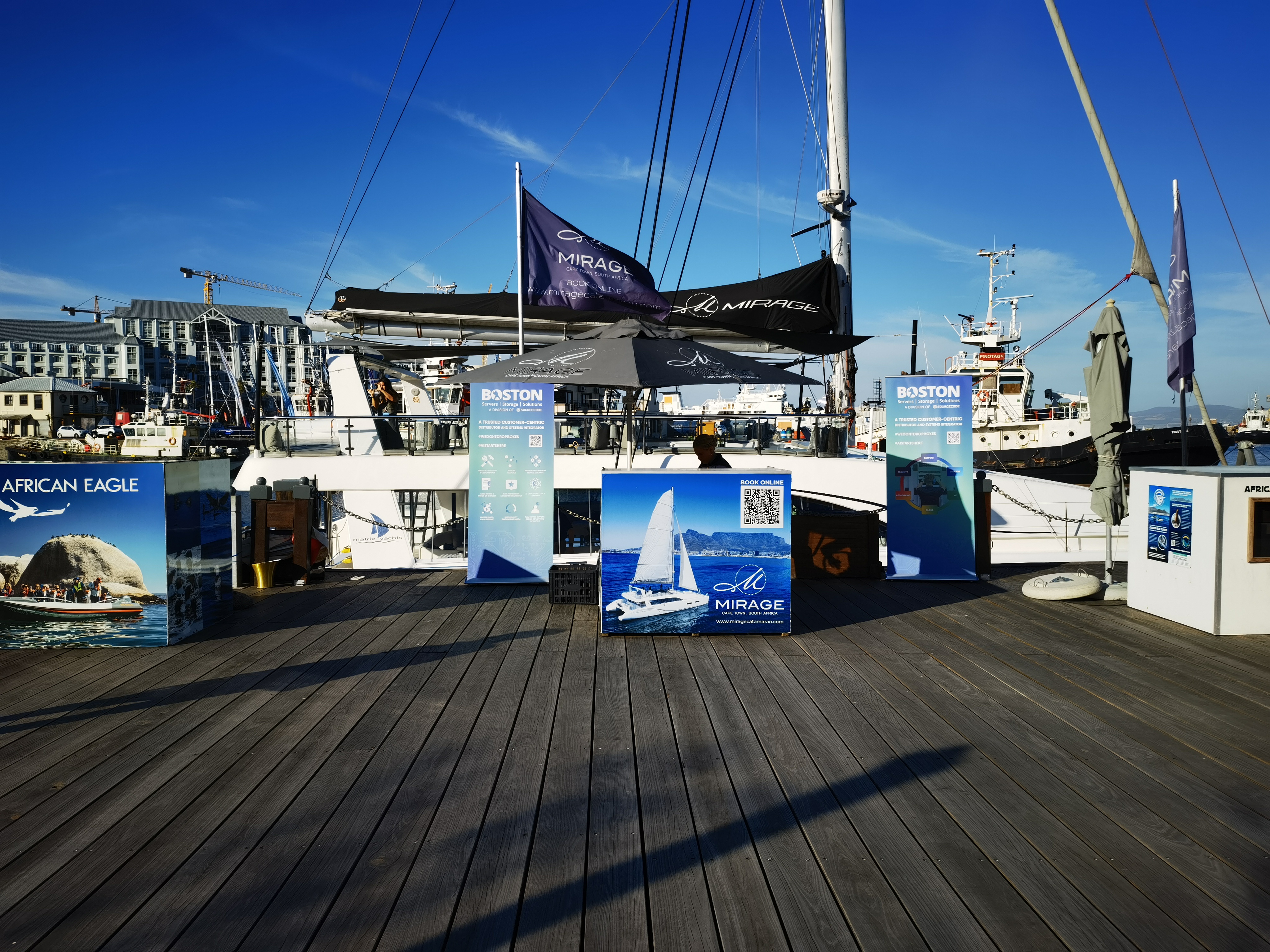
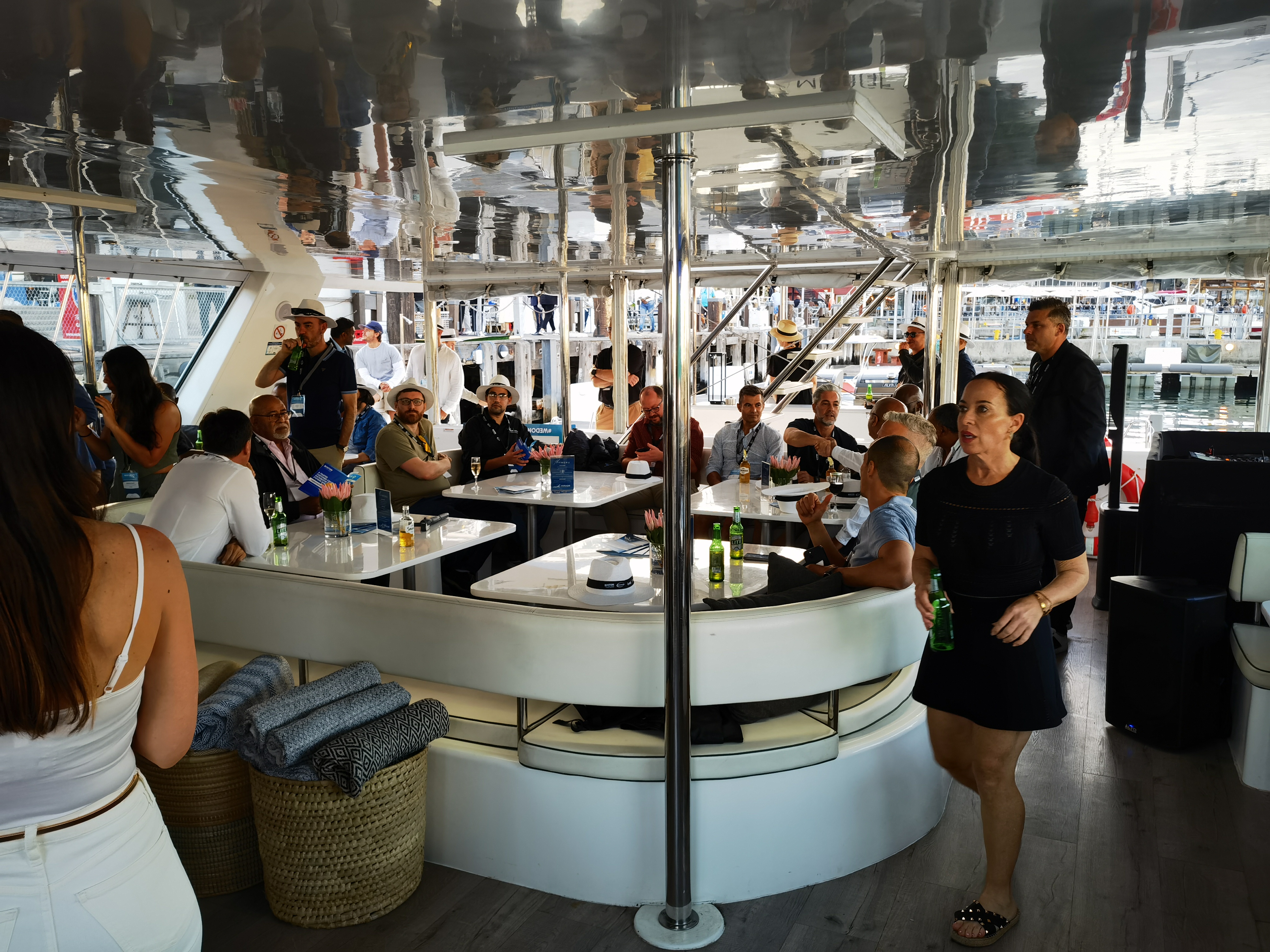
2024 reshaped the cyber landscape. Mitigated web DDoS attacks surged by 549%. Malicious API traffic jumped 188%. And 35% of online traffic is now bot-generated. Attackers are no longer waiting for human intervention, they’re using AI to write exploits, mimic behaviour and relaunch attacks autonomously.
Traditional signature-based security cannot keep pace.
Radware’s message was concise and compelling:
The only way to defend against AI-driven threats is to fight AI with AI.
Their EPIC-AI™ cloud-native platform brings together behavioural analysis, automated reasoning, unified visibility and continuous machine learning to detect anomalies long before signatures exist. This is not a toolset; it’s an intelligent security fabric.
Real-world examples underscored the impact, including telecom operators cutting false positives by 90% and reducing mitigation time to under five seconds, improvements that translate directly into business resilience, lower operational cost and stronger customer trust.
Together with Boston, Radware is enabling Resilience-as-a-Service across cloud, edge and data centre environments, ensuring that Africa’s AI expansion is not only powerful but secure, trusted and sustainable.
Intel
Compute Powering the AI Era
Intel closed the presentation section of the evening by reframing compute as the engine of the AI revolution. While AI is often seen as the spark of innovation, the session reminded us that without the right compute, the spark cannot scale.
A decade ago, compute strategies revolved around throughput: more cores, more servers, more power. Today’s leaders face a far more complex equation, one that balances performance, cost, efficiency and sustainability. As AI workloads intensify and edge data surges, power budgets have become strategic constraints, not technical footnotes.
Intel’s answer: AI Everywhere.
Their discussion explored how enterprises can drive more intelligence per watt, per ZAR / USD and per rack, from the edge to the cloud. Central to this was the Intel Xeon 6 Processor family, engineered to deliver real-world efficiency gains. Attendees heard how refreshing older Xeon systems with Xeon 6 can enable a 5-to-1 server consolidation, slash energy consumption and reduce TCO by nearly 40% over four years.
“… we ask the industry: What are your requirements for your computing environment, what are you trying to achieve? And that’s how we deliver the full range of processors itself.” – Nathan Reddy, Industry Technical Specialist for Intel
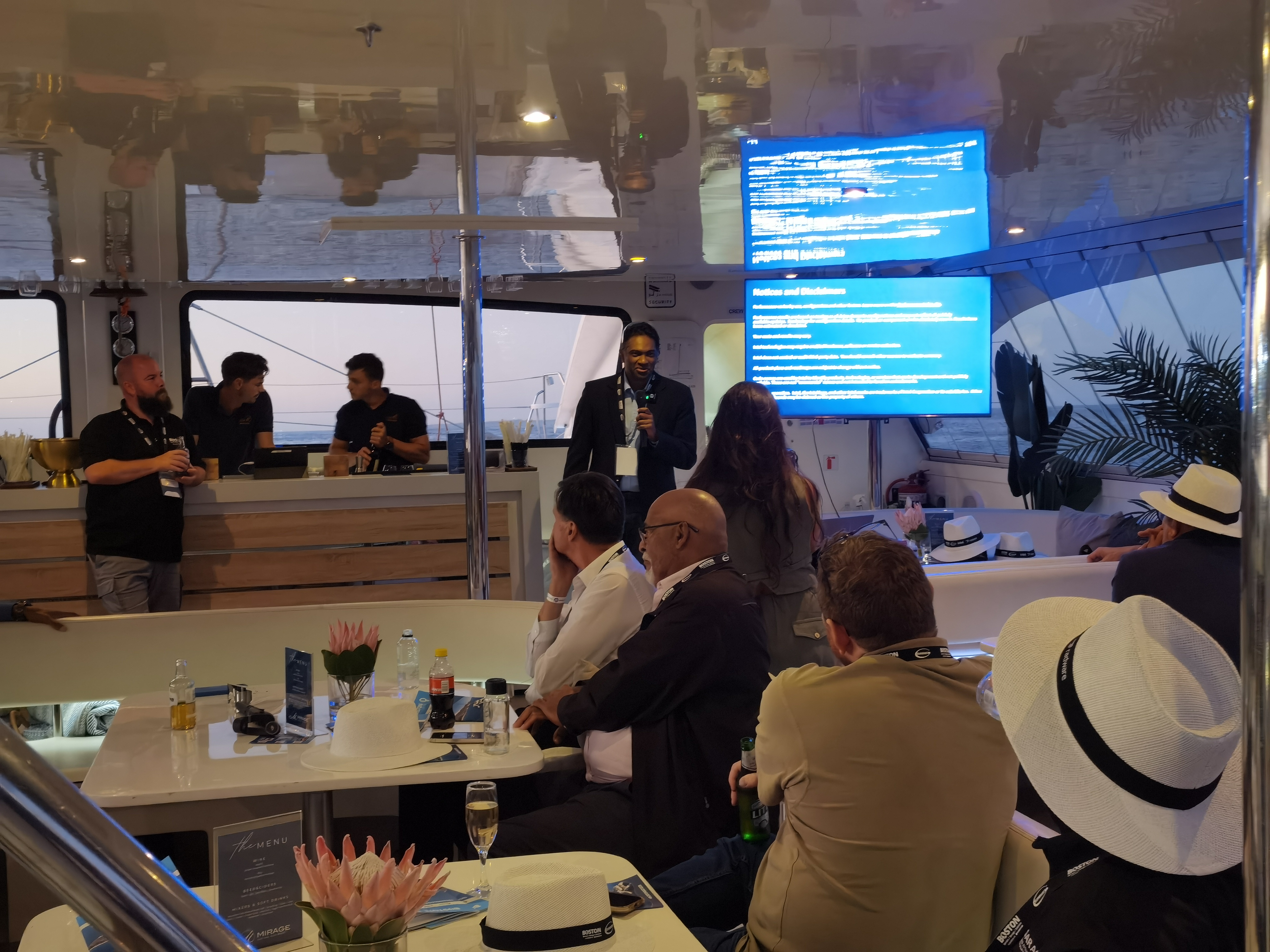
Nathan Presenting
 (1).jpg)
 (1).jpg)
Nathan, Mamello & Ricky
But this wasn’t just about cost savings. It was about climate impact too. By modernising compute, organisations can reduce carbon emissions by up to 30–40%, turning infrastructure upgrades into progress against ESG targets. The message was clear: Africa’s AI growth will rely on open, secure, scalable compute... and Intel is committed to powering that evolution, together with Boston.
A Night of Insight, Connection and Possibility
As the skyline glowed and conversations stretched long after the talks ended, it became clear that this year’s TID was more than an event, it was a shared moment of momentum.
The Mirage provided the perfect backdrop for leaders to exchange ideas, debate challenges and discover opportunities in an environment built for honest conversation. From compute modernisation to liquid-cooled AI factories to autonomous cyber resilience, the evening captured the excitement and urgency of Africa’s digital transformation.
With the continued support of our partners:
- Platinum Partner: Supermicro
- Gold Plus Partner: Radware
- Gold Partner: Intel
We’re committed to helping enterprises across the continent build infrastructure that’s faster, greener, more secure and ready to scale.
Innovation in Africa is accelerating and, together, we’re shaping a future where ideas move faster, power goes further and every organisation has the tools to compete on a global stage.
Here’s to the next wave of collaboration, and to the leaders who are driving Africa’s AI revolution forward.